

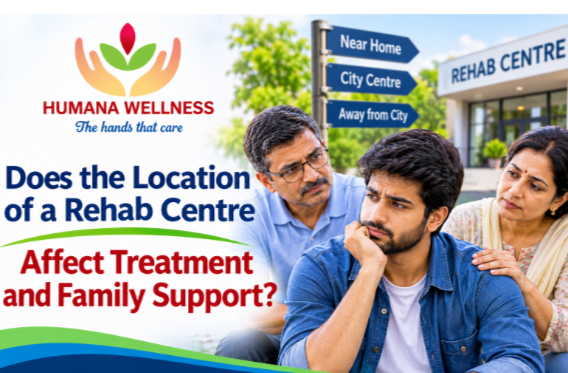
A family may shortlist a centre because it is within driving distance, only to discover that nobody can attend its family sessions. Another may choose a facility farther away and find that the person receiving care feels isolated. Both situations show why location is about more than a pin on a map.
Where treatment takes place can affect admissions, visiting, emergency access, privacy and the support a person receives when they return home. It does not, by itself, tell you whether the treatment will be effective.
Close to home: useful, but not always necessary
For people receiving outpatient care, proximity can make a real difference. Regular appointments are easier to keep when travel is predictable. This matters to someone who is balancing work, childcare, studies or caring for an older parent. If transport is expensive or unreliable, an otherwise suitable programme may become difficult to maintain.
Residential care changes the calculation. The person stays at the facility, so daily commuting is not the issue. Instead, look at family contact, planned visits, access to outside medical care and the journey home after discharge. Some people prefer separation from the social setting in which substance use became frequent. Others benefit from being close enough for family members to participate.
When looking at a rehab centre in delhi, check whether the result is in Delhi itself or the surrounding National Capital Region. A Gurugram address can still be relevant to a Delhi family, but it should be described accurately. Choosing care on the basis of a misleading locality is an unnecessary source of stress.
Think about the week after discharge
Imagine that someone returns home after several weeks of structured care. They may need counselling appointments, a medical review, support for sleep or mood problems, and help rebuilding a daily routine. A centre may have provided good residential support, but the next phase is much harder if follow-up arrangements were never discussed.
Ask before admission whether the team helps arrange continued care near the person’s home. Find out who receives the discharge information, with the patient’s consent, and how the treatment plan is communicated to an outside doctor. If medication has been prescribed, there should be a clear explanation of follow-up and what to do about side effects. Nobody should have to guess what comes next.
A practical aftercare plan may include individual counselling, peer support, family meetings or treatment for an accompanying mental health condition. The mix will differ by person. Some will need more intensive follow-up than others. A short, vague promise of lifelong support tells families less than a named process for the first few weeks.
Privacy is also a location question
Not everyone wants treatment close to their workplace or neighbourhood. In a densely connected city, a person may worry about being recognised or having personal information shared. Those concerns are understandable and should be discussed, not dismissed.
Ask what appears on appointment records, who can access patient information, and how family enquiries are handled. A centre should be able to explain how it seeks consent before sharing clinical details with relatives. The person receiving care should know who will be told about admission and why.
Being farther away does not automatically guarantee privacy. A respectful confidentiality policy, careful record handling and private consultation spaces are more dependable measures. Similarly, a local service should not be ruled out solely because it is nearby.
Visit logistics that families overlook
Before travelling, save the verified location, confirm the full street address and check whether visits require an appointment. The service lists its centre in Sector 46, Gurugram, Haryana. A map pin is useful for reaching the property, but it cannot tell you the current visiting policy or which clinician will be available.
Ask about arrival arrangements for a person who is unwell, particularly if they are distressed or experiencing withdrawal symptoms. They may need medical assessment first. If someone has severe confusion, a seizure, breathing problems or another immediate danger, take them to emergency medical services rather than treating a residential admission as an emergency response.
There are smaller questions worth settling too. Can one relative attend an assessment remotely? Are family sessions conducted on weekdays? Is there a separate space for confidential discussions? How are patients transported for outside medical appointments if needed? These details can affect the household throughout the stay.
What matters more than the postcode?
The quality of assessment, access to appropriate professionals, transparent costs and an individual treatment plan deserve greater weight than address alone. Ask whether the team can explain the difference between managing withdrawal and treating the behaviour, health conditions and circumstances linked to substance use. Detoxification may be an important first step; it is rarely a complete long-term treatment plan on its own.
Expect staff to talk about realistic progress rather than guarantees. Treatment can involve setbacks, changes in motivation and adjustments to care. A service that acknowledges those possibilities may be more useful than one that promises certainty.
Families should also consider their own capacity. Frequent visits may be easy for a household with flexible working hours and difficult for someone caring for children. Neither situation means the family is less committed. A workable plan respects these constraints and uses other forms of contact when appropriate.
The practical question is not simply, ‘Which centre is nearest?’ It is, ‘Can this person receive safe, suitable care here, and can the support continue once they are home?’ Answer that question first, and distance becomes one factor among several rather than the deciding one.